Historical document · Full-text digitization
Michael L. Riordan1997 Interview & Profile of the Gilead Sciences Founder and CEO
“Balms from Gilead” by Kathryn S. Brown — Washington University Magazine, Spring 1997, pp. 31–33
Page 31
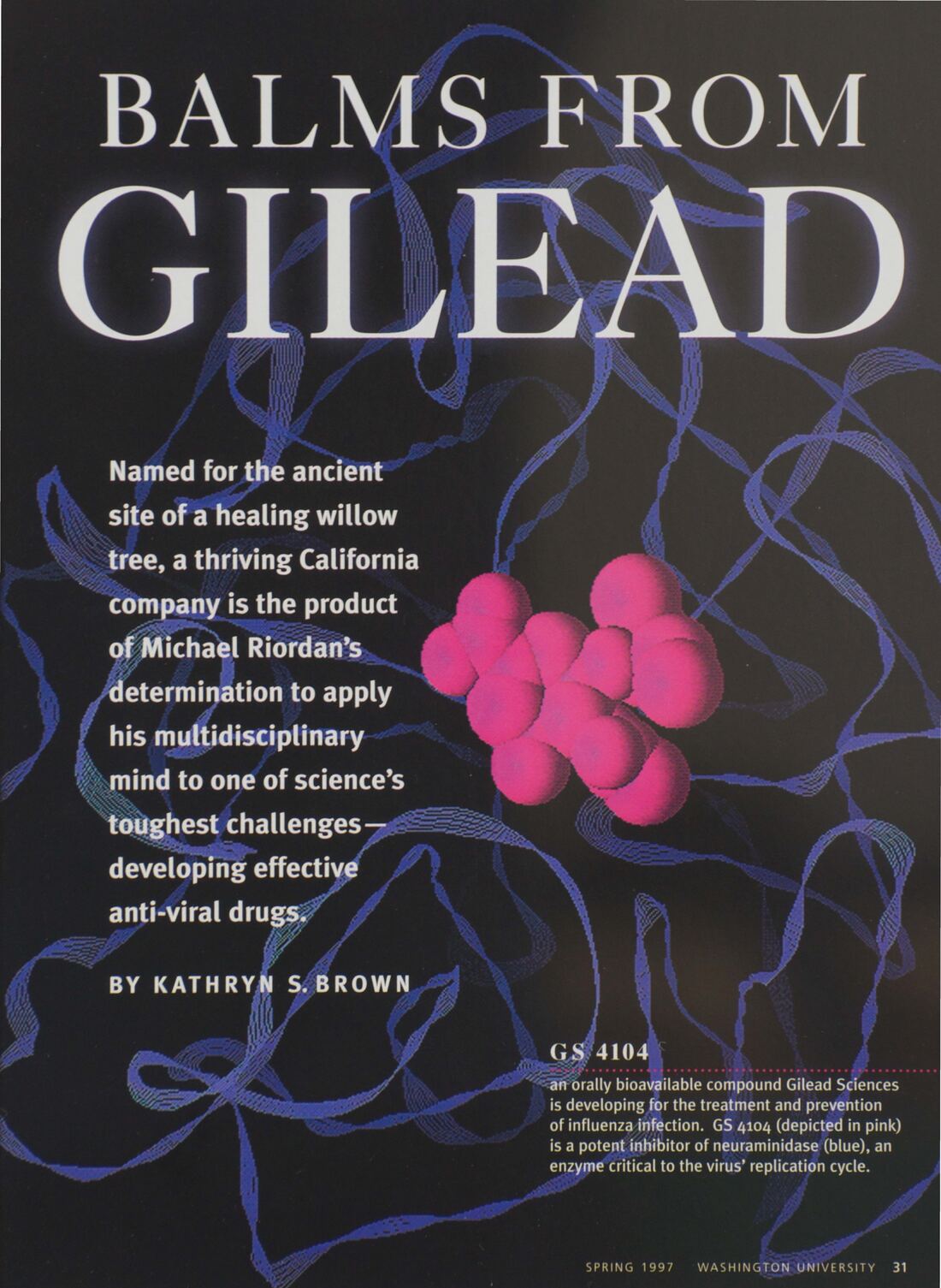
BALMS FROM GILEAD
Named for the ancient site of a healing willow tree, a thriving California company is the product of Michael Riordan's determination to apply his multidisciplinary mind to one of science's toughest challenges—developing effective anti-viral drugs.
BY KATHRYN S. BROWN
Cover-art caption — GS 4104: an orally bioavailable compound Gilead Sciences is developing for the treatment and prevention of influenza infection. GS 4104 (depicted in pink) is a potent inhibitor of neuraminidase (blue), an enzyme critical to the virus' replication cycle.
(Page folio: SPRING 1997 · WASHINGTON UNIVERSITY · 31)
Page 32
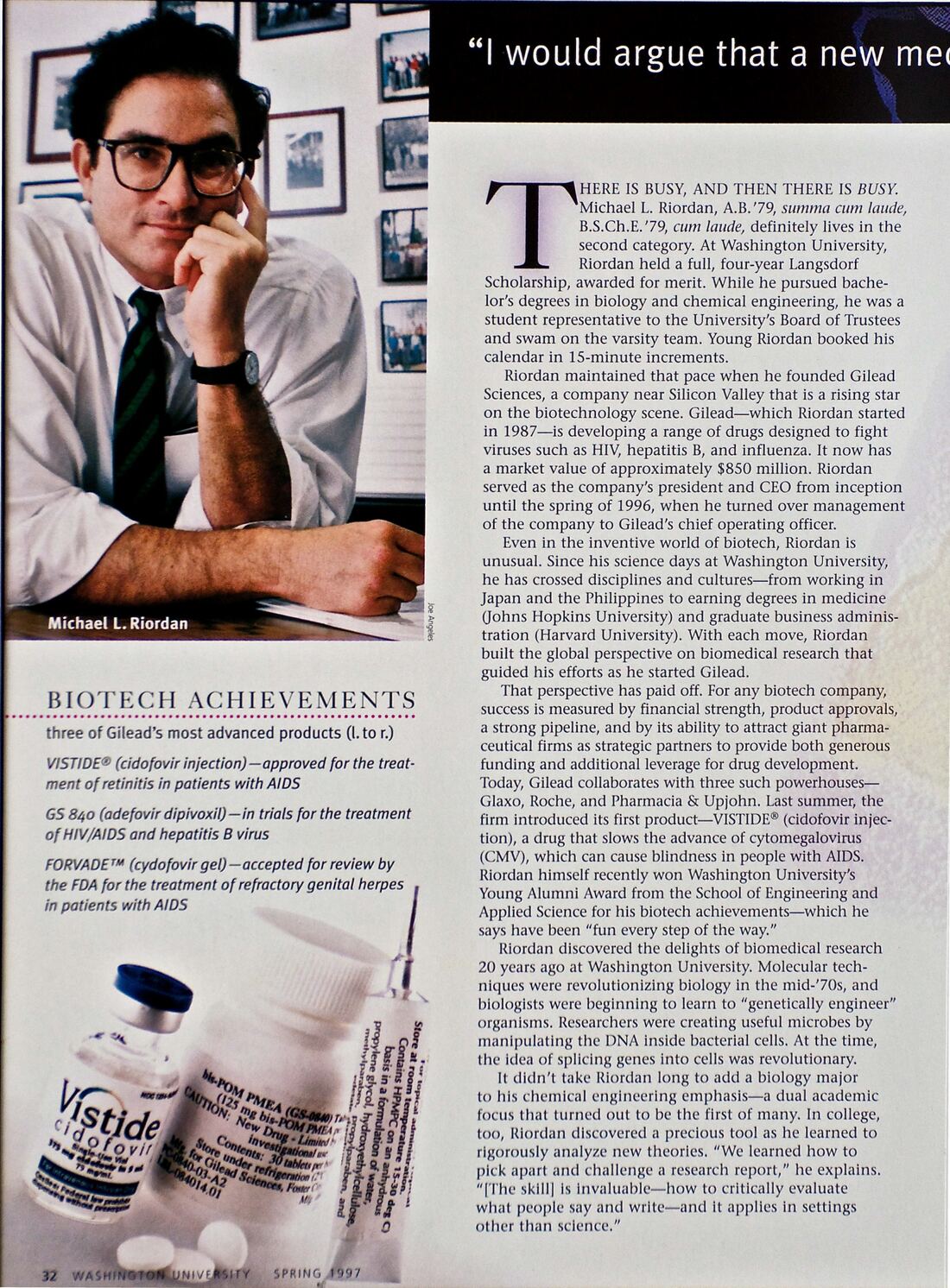
Photograph: Michael L. Riordan, seated at a desk before a wall of framed photographs of the Gilead team. Caption: "Michael L. Riordan." Photo credit: Joe Angeles.
Pull quote (spanning pages 32–33): "I would argue that a new medicine is one of the most complex products to develop."
Reproduced from the original layout; the quotation appears in context in the article’s closing section.
THERE IS BUSY, AND THEN THERE IS BUSY. Michael L. Riordan, A.B. '79, summa cum laude, B.S.Ch.E. '79, cum laude, definitely lives in the second category. At Washington University, Riordan held a full, four-year Langsdorf Scholarship, awarded for merit. While he pursued bachelor's degrees in biology and chemical engineering, he was a student representative to the University's Board of Trustees and swam on the varsity team. Young Riordan booked his calendar in 15-minute increments.
Riordan maintained that pace when he founded Gilead Sciences, a company near Silicon Valley that is a rising star on the biotechnology scene. Gilead—which Riordan started in 1987—is developing a range of drugs designed to fight viruses such as HIV, hepatitis B, and influenza. It now has a market value of approximately $850 million. Riordan served as the company's president and CEO from inception until the spring of 1996, when he turned over management of the company to Gilead's chief operating officer.
Even in the inventive world of biotech, Riordan is unusual. Since his science days at Washington University, he has crossed disciplines and cultures—from working in Japan and the Philippines to earning degrees in medicine (Johns Hopkins University) and graduate business administration (Harvard University). With each move, Riordan built the global perspective on biomedical research that guided his efforts as he started Gilead.
That perspective has paid off. For any biotech company, success is measured by financial strength, product approvals, a strong pipeline, and by its ability to attract giant pharmaceutical firms as strategic partners to provide both generous funding and additional leverage for drug development. Today, Gilead collaborates with three such powerhouses—Glaxo, Roche, and Pharmacia & Upjohn. Last summer, the firm introduced its first product—VISTIDE® (cidofovir injection), a drug that slows the advance of cytomegalovirus (CMV), which can cause blindness in people with AIDS. Riordan himself recently won Washington University's Young Alumni Award from the School of Engineering and Applied Science for his biotech achievements—which he says have been "fun every step of the way."
Riordan discovered the delights of biomedical research 20 years ago at Washington University. Molecular techniques were revolutionizing biology in the mid-'70s, and biologists were beginning to learn to "genetically engineer" organisms. Researchers were creating useful microbes by manipulating the DNA inside bacterial cells. At the time, the idea of splicing genes into cells was revolutionary.
It didn't take Riordan long to add a biology major to his chemical engineering emphasis—a dual academic focus that turned out to be the first of many. In college, too, Riordan discovered a precious tool as he learned how to rigorously analyze new theories. "We learned how to pick apart and challenge a research report," he explains. "[The skill] is invaluable—how to critically evaluate what people say and write—and it applies in settings other than science."
(Page folio: 32 · WASHINGTON UNIVERSITY · SPRING 1997)
Page 33
Full of enthusiasm for medicine, the confident Riordan was about to learn an equally powerful—but very different—lesson. As graduation approached, Riordan planned to accept a Fulbright scholarship to study photochemistry in England. But then he unexpectedly won a Luce scholarship, which offered exposure to several countries in East Asia and a year working for the Ministry of Health in the Philippines. Riordan had to choose. "I was attracted to Asia because my grandparents had met in Japan in the '20s," he recalls. "I didn't think I'd have many opportunities to go to that part of the world." And so Riordan, born and raised in Kansas, picked the Luce scholarship.
The choice changed him forever. In Asia, Riordan was assigned to a malnutrition clinic, where he helped treat starving children without money or food. "I had not seen that before," he remarks. "You might like to think that science and medicine have huge effects, but in developing countries, they are subordinate to the economy and politics." Without money to buy food and provide education to families about basic health, a community does not progress, he says.
Tomorrow's Treatments
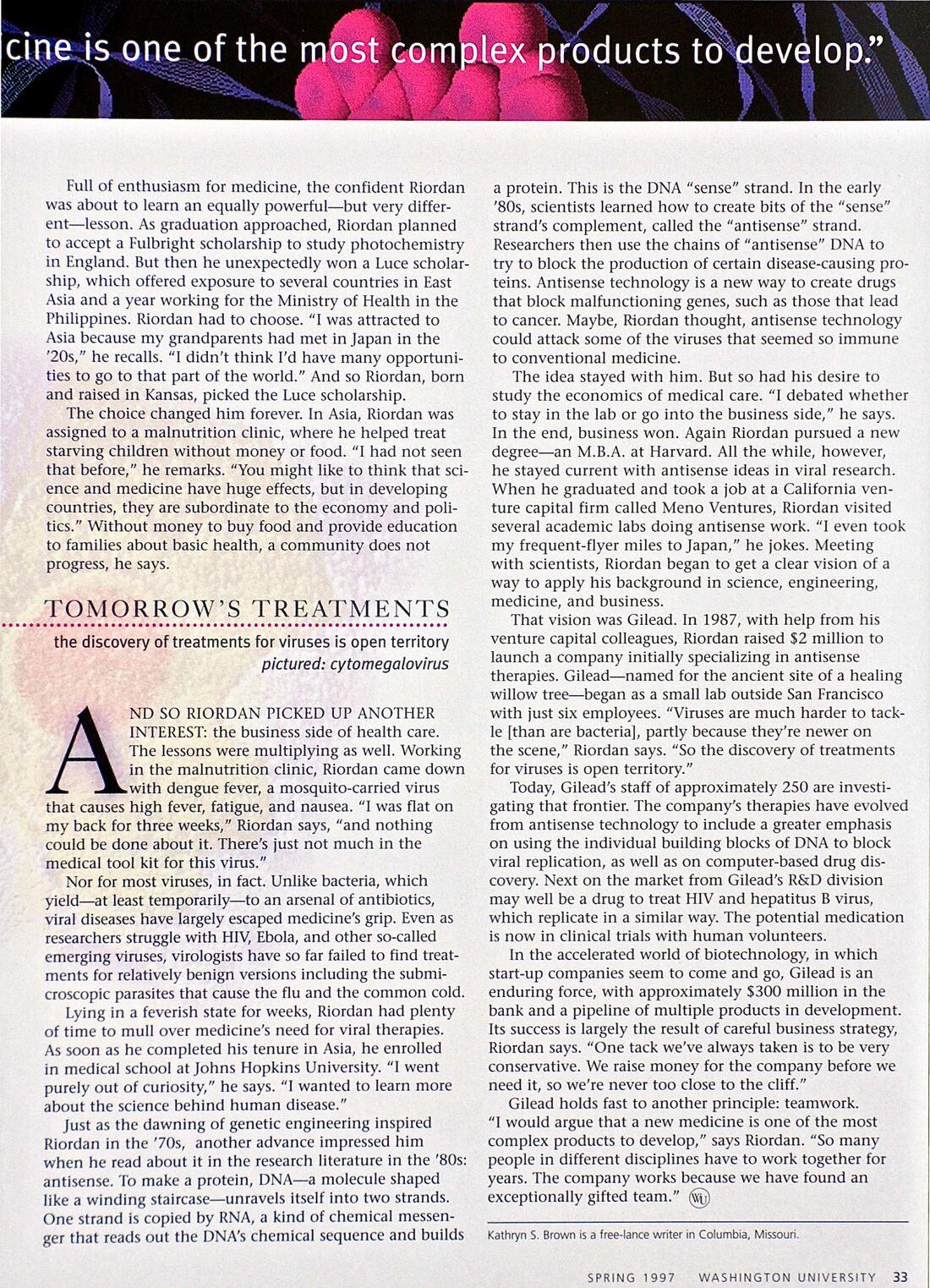
the discovery of treatments for viruses is open territory pictured: cytomegalovirus
AND SO RIORDAN PICKED UP ANOTHER INTEREST: the business side of health care. The lessons were multiplying as well. Working in the malnutrition clinic, Riordan came down with dengue fever, a mosquito-carried virus that causes high fever, fatigue, and nausea. "I was flat on my back for three weeks," Riordan says, "and nothing could be done about it. There's just not much in the medical tool kit for this virus."
Nor for most viruses, in fact. Unlike bacteria, which yield—at least temporarily—to an arsenal of antibiotics, viral diseases have largely escaped medicine's grip. Even as researchers struggle with HIV, Ebola, and other so-called emerging viruses, virologists have so far failed to find treatments for relatively benign versions including the submicroscopic parasites that cause the flu and the common cold.
Lying in a feverish state for weeks, Riordan had plenty of time to mull over medicine's need for viral therapies. As soon as he completed his tenure in Asia, he enrolled in medical school at Johns Hopkins University. "I went purely out of curiosity," he says. "I wanted to learn more about the science behind human disease."
Just as the dawning of genetic engineering inspired Riordan in the '70s, another advance impressed him when he read about it in the research literature in the '80s: antisense. To make a protein, DNA—a molecule shaped like a winding staircase—unravels itself into two strands. One strand is copied by RNA, a kind of chemical messenger that reads out the DNA's chemical sequence and builds a protein. This is the DNA "sense" strand. In the early '80s, scientists learned how to create bits of the "sense" strand's complement, called the "antisense" strand. Researchers then use the chains of "antisense" DNA to try to block the production of certain disease-causing proteins. Antisense technology is a new way to create drugs that block malfunctioning genes, such as those that lead to cancer. Maybe, Riordan thought, antisense technology could attack some of the viruses that seemed so immune to conventional medicine.
The idea stayed with him. But so had his desire to study the economics of medical care. "I debated whether to stay in the lab or go into the business side," he says. In the end, business won. Again Riordan pursued a new degree—an M.B.A. at Harvard. All the while, however, he stayed current with antisense ideas in viral research. When he graduated and took a job at a California venture capital firm called Menlo Ventures, Riordan visited several academic labs doing antisense work. "I even took my frequent-flyer miles to Japan," he jokes. Meeting with scientists, Riordan began to get a clear vision of a way to apply his background in science, engineering, medicine, and business.
That vision was Gilead. In 1987, with help from his venture capital colleagues, Riordan raised $2 million to launch a company initially specializing in antisense therapies. Gilead—named for the ancient site of a healing willow tree—began as a small lab outside San Francisco with just six employees. "Viruses are much harder to tackle [than are bacteria], partly because they're newer on the scene," Riordan says. "So the discovery of treatments for viruses is open territory."
Today, Gilead's staff of approximately 250 are investigating that frontier. The company's therapies have evolved from antisense technology to include a greater emphasis on using the individual building blocks of DNA to block viral replication, as well as on computer-based drug discovery. Next on the market from Gilead's R&D division may well be a drug to treat HIV and hepatitis B virus, which replicate in a similar way. The potential medication is now in clinical trials with human volunteers.
In the accelerated world of biotechnology, in which start-up companies seem to come and go, Gilead is an enduring force, with approximately $300 million in the bank and a pipeline of multiple products in development. Its success is largely the result of careful business strategy, Riordan says. "One tack we've always taken is to be very conservative. We raise money for the company before we need it, so we're never too close to the cliff."
Gilead holds fast to another principle: teamwork. "I would argue that a new medicine is one of the most complex products to develop," says Riordan. "So many people in different disciplines have to work together for years. The company works because we have found an exceptionally gifted team."
Kathryn S. Brown is a free-lance writer in Columbia, Missouri.
(Page folio: SPRING 1997 · WASHINGTON UNIVERSITY · 33)
About this digitization
This page reproduces, as machine-readable text, “Balms from Gilead,” from Washington University Magazine, Spring 1997, transcribed by OCR from a scan of the original printed copy and checked against the high-resolution page images shown above. Presented for historical, educational, and archival reference.